
Okta and SyncSignature
Okta manages your users. SyncSignature manages their email signatures. When Okta provisions or updates a user in Google Workspace or Microsoft 365, SyncSignature reads from the directory every 24 hours, or on demand with one click, and keeps the signature current.
From $15 a month for up to 5 users. Annual billing. No card required for trial.
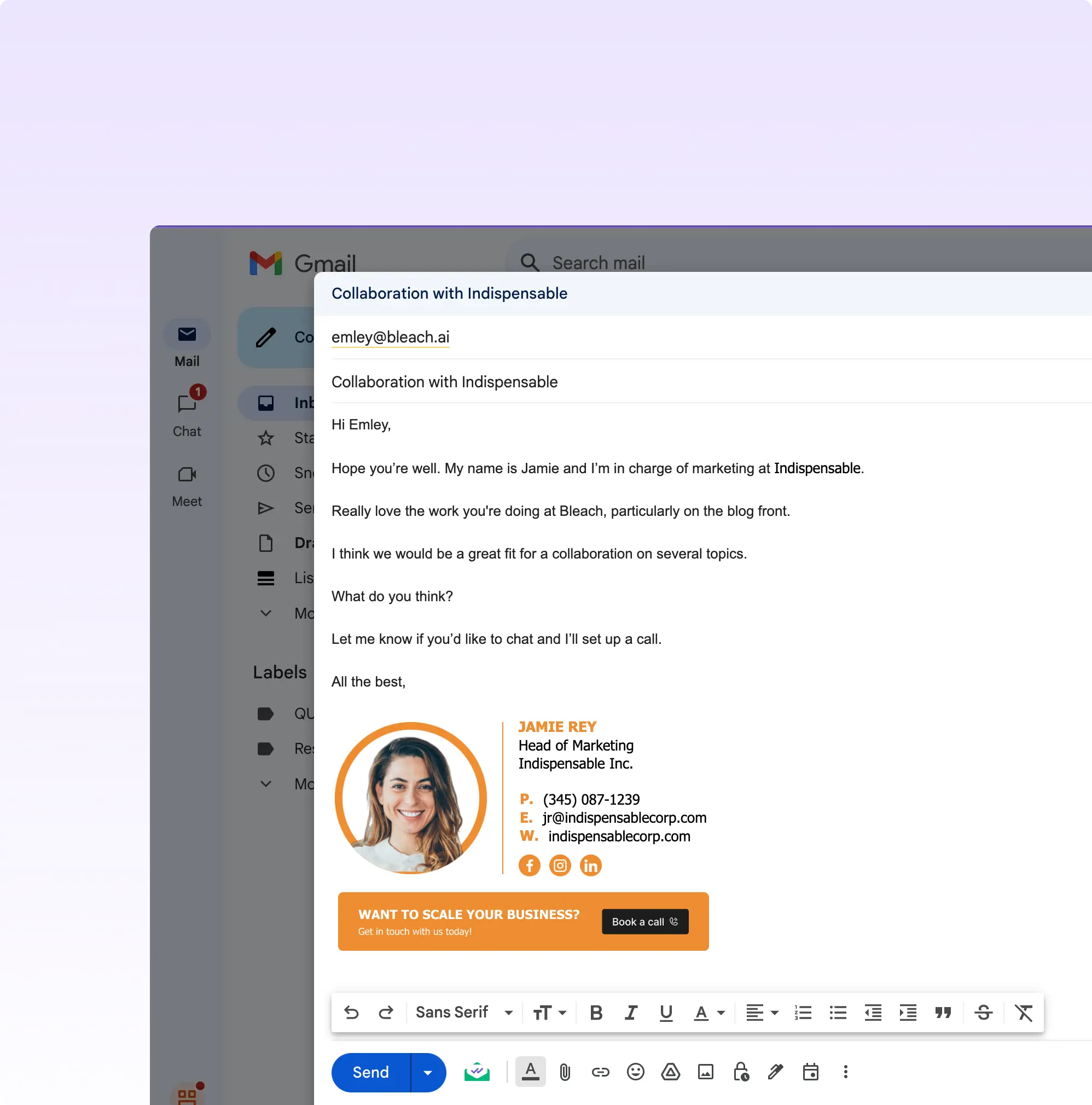
How Okta and SyncSignature work together
SyncSignature does not connect to Okta directly. The integration works through the directory layer. Okta provisions users into Google Workspace or Microsoft 365 through its Lifecycle Management connectors in the Okta Integration Network. Okta to Google Workspace uses Okta's Google Workspace provisioning connector. Okta to Microsoft 365 uses Okta's Microsoft Office 365 provisioning connector, which pushes into Azure AD (Entra ID).
SyncSignature connects to Google Workspace via the Admin SDK and Gmail API, or to Microsoft 365 via Microsoft Graph API and an Outlook add-in deployed through Microsoft 365 Centralized Deployment. Once those connections are in place, any user change Okta propagates into the directory, including new hires, role updates, group membership changes, and deprovisioning, is picked up by SyncSignature on its next sync, which runs every 24 hours, or on demand with one click.
How changes propagate, end to end
Okta is faster than any HRIS in the provisioning chain. When an admin changes a user attribute or group membership in Okta, Okta's push provisioning to Google Workspace or Microsoft 365 typically completes in minutes, not hours. SyncSignature then picks up the directory change on its next sync, which runs every 24 hours, or on demand with one click when a change cannot wait.
Three scenarios where this matters. First, same-day role changes. A mid-market company promotes an IC to manager at 10 AM. Okta updates the title, and Okta's provisioning carries it into the Google Workspace directory within a few minutes. SyncSignature rewrites the signature on its next sync, every 24 hours, or on demand with one click if the admin wants it live the same morning. Without this pipeline, the signature update waits for someone to manually edit a template.
Second, urgent deprovisioning. A contractor's engagement ends effective immediately. Okta deactivates the account, and Google Workspace suspends the mailbox in minutes. SyncSignature removes the signature assignment on its next sync, every 24 hours or on demand with one click. The contractor cannot send another email, and if they somehow could, the signature no longer claims affiliation with the company.
Third, group-based campaigns. A new banner campaign targets the engineering team. IT moves a new hire into the Engineering group in Okta on their first day. The group membership propagates to Google Workspace. SyncSignature picks up the group change and assigns the engineering template and the active banner. No separate step.
HRIS-driven pipelines like BambooHR or Workday reach the directory more slowly. BambooHR's default sync is 6 hours. Workday runs nightly. With Okta, the directory is current in minutes, so the only wait is SyncSignature's own sync, every 24 hours or on demand with one click.
How it works
Three systems, one automatic pipeline. When Okta updates a user, the change flows to SyncSignature without manual steps.
Users are managed in Okta
Okta is your source of truth for identities. Provisioning, deprovisioning, role changes, and group memberships are managed in Okta. Okta Universal Directory holds user records pulled from HRIS systems or Active Directory.
Okta provisions users into Google Workspace or Microsoft 365
Using Okta's Lifecycle Management connectors from the Okta Integration Network, user changes propagate into Google Workspace or Microsoft 365. New users get directory entries in minutes. Deprovisioned users are removed just as fast. Group memberships flow through if the group push feature is enabled.
Connect SyncSignature to your email platform once
In SyncSignature, authenticate with your Google Workspace super-admin account, or connect your Microsoft 365 tenant through the Microsoft Graph API consent flow and deploy the Outlook add-in via Microsoft 365 Centralized Deployment. SyncSignature reads the directory and assigns signature templates based on user attributes, groups, or departments.
Every Okta change flows through to signatures
When Okta pushes a user update into the directory, SyncSignature picks it up on its next sync, every 24 hours or on demand with one click, and updates or removes the signature accordingly.
What this covers
User lifecycle events managed in Okta flow through to email signatures without a secondary tool or a manual process. IT does not maintain a separate signature management workflow. New starters get correct signatures on the next sync after their Okta activation, and role changes update signatures the same way. SyncSignature syncs every 24 hours, or on demand with one click. When a user is deprovisioned in Okta and removed from the directory, their signature assignment is removed automatically.
Group-based signature targeting works if Okta's group push feature is enabled for Google Workspace or Microsoft 365. Engineering teams, sales teams, regional offices, and business units can all receive different signature templates automatically based on the groups Okta pushes.
What SyncSignature does not do with Okta
SyncSignature does not have a connector in the Okta Integration Network. As of 2026-04-08, there is no SyncSignature listing in OIN. The integration path runs through the directory layer, not through an OIN connector.
SyncSignature does not expose a SCIM endpoint. Okta cannot provision users directly into SyncSignature. Provisioning into SyncSignature is driven entirely by directory reads from Google Workspace or Microsoft 365.
SSO login to the SyncSignature admin panel via Okta is not supported. You sign in to SyncSignature with email and password or with your Google account.
Okta does not push profile photos to Google Workspace or Microsoft 365 by default. Signature templates that use profile photos need either a custom attribute configuration in Okta or a separate photo source.
If Okta is configured to push users into on-premise Active Directory or on-premise Exchange, not into Azure AD or Google Workspace directly, SyncSignature cannot read from there. The path requires a cloud directory endpoint.
Okta alone vs Okta with SyncSignature
| Capability | Okta alone | Okta + SyncSignature |
|---|---|---|
| Email signature central management | Admin-managed templates | |
| Signatures match Okta role changes | Manual per-user | Automatic, every 24 hours or on demand |
| Group-based signature targeting | Automatic via Okta group push | |
| Deprovisioning of signatures | Manual cleanup by IT | Automatic on the next sync |
| New hire signature on day one | Manual setup by user | Automatic on the next sync, or on demand |
| Signature link click analytics | ||
| Banner campaigns | ||
| Multi-brand signatures |
Pricing
SyncSignature Teams is $15 a month for up to 5 users, then $2 per user per month in bands of five from 6 users, billed annually. Includes directory sync, signature templates, group targeting, banner campaigns, and click analytics. 7-day free trial, no card required.
Annual billing only. Pricing is $15 a month for up to 5 users, then $2 per user per month in bands of five from 6 users, scaling down to $1.44 per user at 100 users. The Solo plan at $6 per month covers individual users. The Agency plan covers unlimited clients with per-client workspaces and scoped admin roles.
Okta and SyncSignature: common questions
No. SyncSignature does not have a native Okta connector or a SCIM endpoint. The integration runs through the directory layer. Okta provisions users into Google Workspace or Microsoft 365 through its Lifecycle Management connectors. SyncSignature reads from the directory and keeps signatures current from there.
Not as of 2026-04-08. The integration path runs through the directory layer, not through an OIN connector. This means there is no Okta-side app to install or configure for SyncSignature. All configuration is done once on the Google Workspace or Microsoft 365 side.
No. SyncSignature does not expose a SCIM endpoint. The integration works by reading from the Google Workspace or Microsoft 365 directory that Okta provisions into, not by receiving SCIM push from Okta.
No. You sign in to SyncSignature with email and password or with your Google account. SAML SSO, including Okta SSO for the admin panel, is not available today.
On SyncSignature's next sync, which runs every 24 hours, or on demand with one click. Okta pushes the user into Google Workspace or Microsoft 365 in minutes, and SyncSignature's next sync picks up the new directory record and assigns the correct signature template.
Okta removes or suspends the user in Google Workspace or Microsoft 365 in minutes. SyncSignature detects the change on its next sync, every 24 hours or on demand with one click, and removes the signature assignment.
No. Okta Universal Directory is read only by Okta. SyncSignature reads from Google Workspace or Microsoft 365, which Okta provisions into.
Yes, if Okta's group push feature is enabled for the downstream app. By default, Okta pushes users and attributes but not group memberships. Enabling group push on the Google Workspace or Microsoft Office 365 provisioning app in Okta makes groups available to SyncSignature.
On-premise Active Directory and on-premise Exchange are not supported. SyncSignature requires Google Workspace or Microsoft 365 as the directory endpoint. If Okta is configured to provision into on-premise AD without a Microsoft 365 hop, this integration path does not apply.
SyncSignature Teams is $15 a month for up to 5 users, then $2 per user per month in bands of five from 6 users, billed annually. Pricing scales down to $1.44 per user at 100 users. 7-day free trial, no card required.
Connect Okta to your email signatures in under 30 minutes
Authenticate Google Workspace or Microsoft 365 once. Okta's push provisioning does the rest.
Teams from $15 a month for up to 5 users. Annual billing. No card required for trial.